Managing Bad Leads
Last updated: February 19, 2026
Stop Bad Leads Before They Reach Your Sales Team
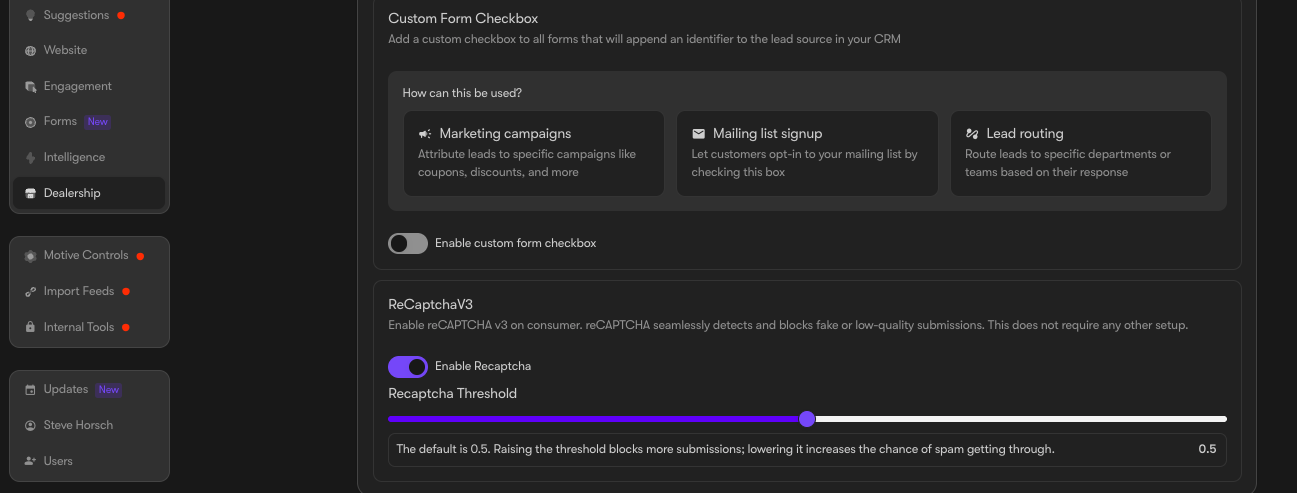
Motive can implement reCAPTCHA v3 to seamlessly detect and block fake or low-quality submissions without adding friction for real customers. Unlike traditional CAPTCHAs, reCAPTCHA v3 runs in the background, assigning a risk score to every lead form submission. This helps filter out bots and spam entries automatically—keeping your CRM clean, your sales team focused on real prospects, and your cost per qualified lead lower.
You can enable this feature by going to Dealership → Lead Settings → Form Settings and scrolling to the bottom of the page.
You can also adjust the bot detection threshold. Increasing the threshold will block more submissions, while lowering it may allow more spam through.
The above can be implemented by Motive as a preventative measure, but it’s also important to understand why you might still be receiving bad leads. The following information offers practical tips to help stop a sudden influx of low-quality leads.
Why am I suddenly getting an influx of bad leads?
What's happening?
You're seeing leads come from a strange URL: https://syndicatedsearch.goog/. These leads:
Land on a page
Wait about a minute
Submit a lead form
Never come back or respond
They look like real people to your system (because reCAPTCHA gives them a good score), but no one on your team can actually get in touch with them. This is a common pattern across many companies. So who’s submitting these?
These leads are most likely being created by:
Bots – automated systems pretending to be humans.
Low-quality click farms – people paid a few cents to click ads and fill out forms.
Incentivized users – people who are rewarded (e.g., gift cards) for submitting forms, even if they’re not interested in buying a car.
They’re not real, interested customers. Why is this happening?
It’s usually tied to Google Ads — especially something called Performance Max or Smart Campaigns.
Here’s how it likely works:
You (or someone you work with) is running Google Ads to get more leads.
Google tries to get you the most leads possible for the lowest cost.
Google shows your ads on weird partner sites or in apps where bots or low-quality traffic live.
These fake users click the ad, land on your site, fill out a lead form — and Google counts that as a successful result.
You get charged for the click or lead — but it’s worthless.
Google still sees this as a success because it technically drove a lead. What should you do?
Start ignoring or blocking traffic that comes from
syndicatedsearch.goog— these leads are almost certainly fake.Talk to whoever manages your Google Ads (or your marketing agency/vendor) and let them know:
You’re getting junk leads from this source.
You want to stop optimizing for lead submissions and instead optimize for actual qualified leads — people who respond or are contactable.
Ask if you're running Performance Max or Smart Campaigns and if they can exclude bad placements.